The calendar for the ninth centenary of the Translation of Saint Nicholas: thirteen plates, a work for four hands.
Lillo DellinoCarmela Boccasile
A calendar for four hands
In 1987 Bari celebrated nine centuries since the relics of Saint Nicholas arrived from Myra. For the Basilica’s calendar, Lillo Dellino and Carmela Boccasile painted thirteen plates – the cover and the twelve months – taking turns, month after month.
Each plate depicts a moment of the Translation, following the chronicle of Nicephorus (11th century), and hides the monuments of the Basilica in its details. The thirteen plates are on permanent display at the Fondazione Puglia.
“Legend and history, devotion and art, faith and culture thus meet and merge into a single descriptive element: drawing.”
Fr. Giovanni Distante, O.P., from the back of the calendar, 1986
At the entrance
Maggio di BariMay in BariCarmela Boccasile · 2001 · oil on canvas · 160 × 160 cmBrowse the calendar
The 1987 calendar
Thirteen images for nine centuries of history
The descriptions of the plates are by Fr. Giovanni Distante, O.P., editor of the Bollettino di San Nicola, from the back of the calendar (1986). The passages from the chronicle of Nicephorus follow the Italian translation by Pasquale Corsi, from which they are rendered here.
Lillo DellinoCarmela Boccasile
Cover
Lillo Dellino
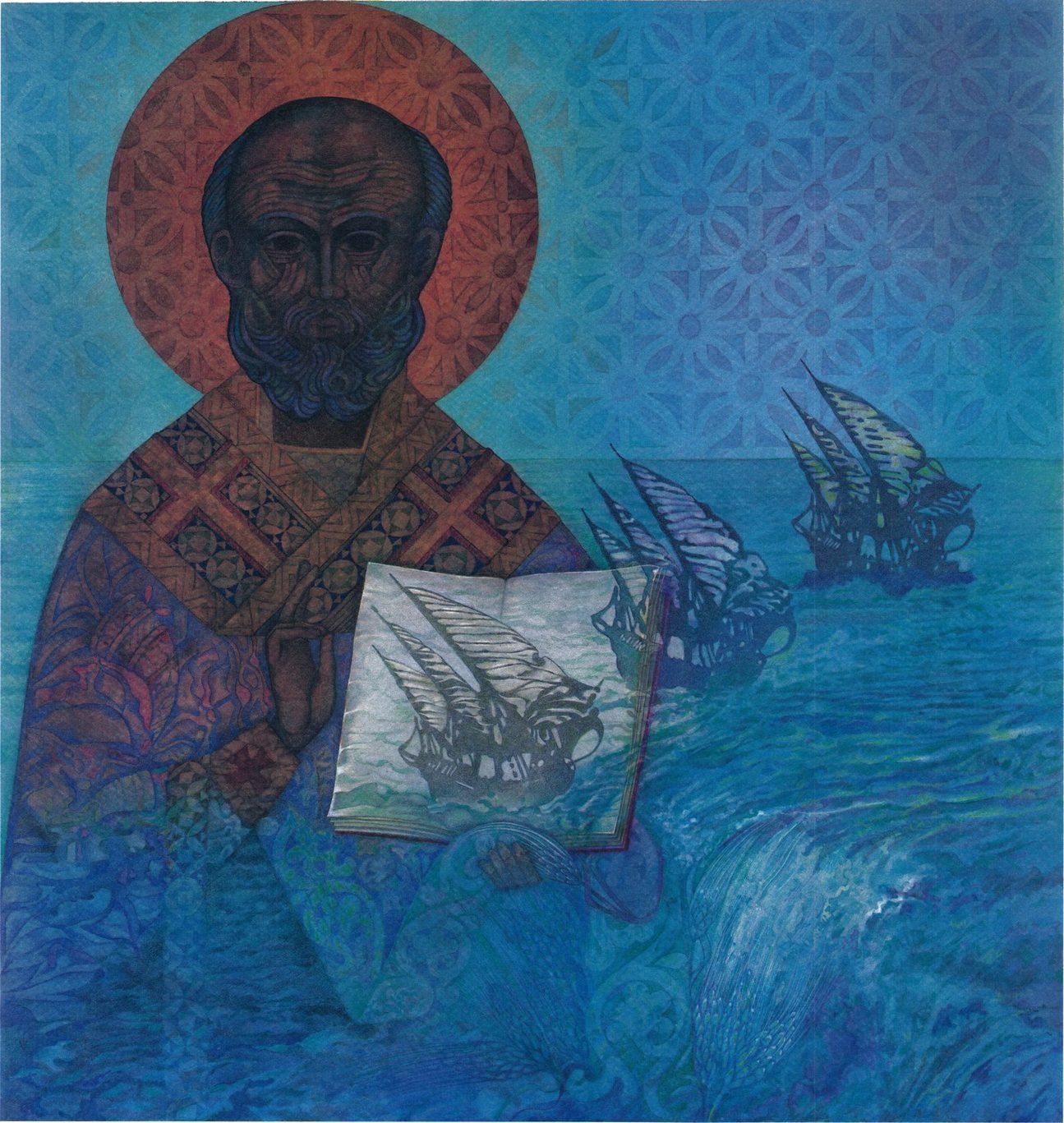
Emblem of the ninth centenary
Mixed media on card · 80 × 80 cm · 1987
We could call it the graphic emblem of the ninth centenary, for it fully evokes the essential elements of the whole event: the figure of the Saint, the small ship of the expedition, the sea (the bond between East and West), the number nine in Roman numerals, taken from the mosaic floor of the church, and the two commemorative dates: 1087–1987.
Although the Saint is portrayed in typically Eastern iconography, he begins to take on Western decorative elements… those of the throne of Abbot Elias. From the sacred book the three small ships of the expedition burst forth, as if to show that the holy theft was willed by Providence. The sky lights up with countless daisy-shaped stars, which again recall the openwork of Abbot Elias’s throne. The ears of wheat, with which the ships of Bari were laden, are a sign of the abundance of the Saint’s new homeland.
The account of Nicephorus
“…When almighty God decreed, in his hidden and supreme will, that the city of Bari and the whole region of Apulia should be inhabited and adorned by an everlasting and most radiant splendour, this came to pass through the working of his divine providence. For it happened that some wise and eminent men of Bari went to Antioch, with their ships laden with grain and other goods. To them came the inspiration to carry away (with God’s help) from the city of Myra, on the outward voyage or on the return, the body of the most blessed Nicholas, confessor of Christ.”
Saint Nicholas appears in a dream and makes known his decision to move elsewhere… While the reasons behind the Translation remain wrapped in the mystery of the providential design, the dream described by Nicephorus is enclosed by Boccasile in a fine frame that recalls the delicate friezes at the foot of the Basilica’s central apse. The sleeper is placed beneath the ciborium, as if to give him a foretaste of the Saint’s future dwelling. In the distance is the void left by the Saint’s outline on the mountains, which those who know the area will recognise as the ones near the city of Myra.
The account of Nicephorus
“…Nicholas, the servant of God, appeared to three of his sacristans, commanding them in a vision to make known to the inhabitants of this city of Myra – who for fear of the Turks had taken refuge on a mountain about twelve stadia away – that either they should return to live in and guard this city, or they should know for certain that he would depart elsewhere.”
The daring of young Matteo, the boldest of the 62 sailors, is fully mirrored in that of the artist, who sought, as it were, to identify himself with the experience of that fortunate man of Bari as he touched the relics of the Saint. It is not the lid of the tomb in Myra that is shattered, but one of the “seals” of the tomb in Bari, broken by Matteo, from which a fragrance rises that seems to reach each one of us today.
The account of Nicephorus
“…They found a sarcophagus of the whitest marble (…) The boldest of them all (…) striking hard, shattered the lid with a menacing blow. When it was opened, the tomb was found full of the holy liquid (…) And at once there followed so extraordinary a fragrance that all thought they were in the divine paradise. And this fragrance reached not only those present, but also (on the favourable breath of the winds) their other companions down by the sea.”
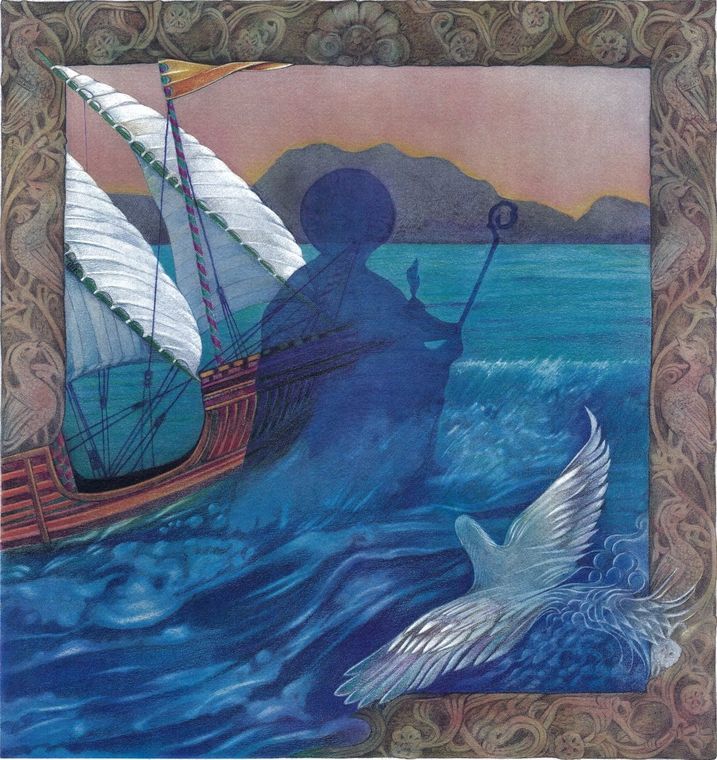
Mission accomplished. Thus begins the “procession at sea” that is engraved in the memory of every Barese. The barely sketched outline of the Saint begins to take on typically Western features. The scene reaches moments of high poetry through the praise of the creatures, symbolised by the bird, giving thanks to the Creator for such an event. The frame recalls elements of the right-hand jamb of the Basilica’s central portal… It is the prelude to the triumphal entry into Bari.
The account of Nicephorus
“…While they were sailing on the open sea, a little bird came to them (…) Chirping sweetly, it gently touched with its tiny beak the cask in which the holy relics were enclosed (…) The brushing of its beak is to be understood as a kiss, which it devoutly offered to the holy body. As it sang, it flew around each ship and around the men, as if to show that it wished to praise and bless them all, for they were carrying so magnificent and extraordinary a shepherd.”
The arrival of the relics in Bari is a feast for everyone. It is the feast of a people, of a city, of an entire region. The ships of the expedition have reached the port of San Giorgio. And so the joyful procession winds its way towards Bari. It is the May Festival… In the figures one can savour the friezes of the 11th-century Byzantine pluteus kept in the Museum of Saint Nicholas.
The account of Nicephorus
“…They did not turn aside towards any place, for the holy confessor of Christ encouraged them. At last, when they reached the harbour of Saint George, martyr of Christ, four miles from the city of Bari, they made an urn in which they laid the holy body, taking it out of that small cask.”
The joy of an entire region is joined to the certainty of at last possessing a treasure. The sky fills with shining stars – the ones we find on the open single-light windows of the Basilica’s east front. The people are dressed for the feast, and the girls display their rich, finely embroidered dresses, with ornaments taken from the lunette of the Lions’ Portal (woman on the left) and from the right-hand jamb of the central portal (woman on the right). A woman dressed in red holds a richly patterned cloth with motifs borrowed from the capitals of the Basilica’s colonnade.
The account of Nicephorus
“…O Bari, companion of the heavenly Jerusalem, rejoice and be glad with all who dwell in you, for countless graces! Rejoice, O Bari, filled beyond measure with every delight! Rejoice, O Bari, full of countless praises! Rejoice, O Bari, for you receive within you a new inheritance of salvation! Rejoice, you who are held most worthy of praise among all the cities of Apulia. Rejoice, you who are crowned for a triumphant victory! For Nicholas in Greek means ‘victory of the people’; and truly he has conquered, in taking under his protection the people of Bari and all of Apulia, freeing them from the bondage of disease.”
The building of the “most splendid and magnificent church in honour of the most blessed Nicholas”, the work of all the people of Bari, is fully part of the providential design. Abbot Elias, the true soul of the undertaking, already foresees the works of art and monuments that will enrich the Saint’s new dwelling and make it famous.
The account of Nicephorus
“…The people of Bari built (…) a most splendid and magnificent church in honour of the most blessed Nicholas (…) From the foundations onward, the work was directed, with the help of noblemen of Bari, by that same lord Abbot Elias who had charge of the custody of the holy body.”
On the great book the historic date is inscribed: 1087. It seals the now unbreakable bond between the holy Bishop of Myra and the city of Bari. The archivolt of the central portal encloses the whole scene, as if to shield from furtive glances the relics of the Saint, who is portrayed as in the icon set into the east front of the Basilica.
The account of Nicephorus
“The most holy body of Saint Nicholas, confessor of Jesus Christ, was thus carried away from the city of Myra on 20 April; on 9 May, a Sunday, at sunset, it was translated to Bari. It was the year of the Lord’s Incarnation 1087, in the tenth indiction.”
God’s mercy is for everyone, especially for the sick who flocked from every side. The “healing liquid that rises from the tomb” of the Saint is jealously kept in a “bottle of the manna” set on a capital of the church’s iconostasis. Here Lillo Dellino succeeded in capturing the truest symbol of the power of the miracles worked by the Saint. The palm, a recurring motif in the capitals of the Basilica, points to the “triumph” of Christ, to whom Nicholas bears witness.
The account of Nicephorus
“And now, if God helps me, I shall tell how, as soon as the news of the arrival spread, the sick with every kind of illness hurried from every part of the city and, having come with great devotion to the aforesaid monastery, were restored to good health. Among them, that night and on the following Monday, forty-seven people of both sexes and of every age were healed. …On the following Tuesday, amid the crowd of those who had come from the villages, towns and cities round about, nine sick people were healed in the aforesaid monastery (…) After we had carried the holy body, that same day, into the aforesaid court, fourteen sick people were cured (…) On the Wednesday after, twenty-nine of the infirm were healed.”
The miracles continue. The scent of paradise is in the air; that fragrance which spreads so sweetly after the miracle is portrayed by flowers taken from the motifs of an 11th-century Byzantine sarcophagus now in the Museum of Saint Nicholas. The frame enclosing the angel and the healed woman takes up the dominant motif of the original frontal of the Basilica’s high altar (12th century), also in the same museum.
The account of Nicephorus
“…A woman from the village of San Vito, (…) carefully questioned by me about what she had seen at the moment she was healed, replied that a great falcon had come over her and alighted on her breast (…) When it flew away, at once there spread a fragrance so sweet that one would think oneself in the joy of Paradise. From this we must faithfully believe that it was the angel of our holy confessor, who keeps unceasing watch over the holy body.”
Nicholas is everyone’s Saint. The universality of his cult is underlined in the account of the “ecumenical” journey the Saint makes to Greece just after his arrival in Bari. Nicholas is a source of hope for all. The artist conveys this message in his splendid rendering of the miracle of the possessed youth, a sign of the passage from death in sin (the possessed youth) to new life in Christ (the angel). The whole scene is “upheld” by a detail of the central portal showing monstrous beings (the personification of sin) and the horsemen who fight them.
The account of Nicephorus
“On the Thursday, the (…) confessor of God revealed himself in a vision to a venerable monk, bidding him tell all who despaired of being healed that he, by the will of almighty God, was setting out for the lands of Greece; but that before he left they would see a great miracle accomplished, as indeed came to pass. For that same day, before dawn, a young man was healed who for five years had been possessed by a demon, deaf, mute and blind (…) And again, at the ninth hour on the Saturday, when Saint Nicholas returned, eleven sick people recovered the health they had lost.”
Saint Nicholas, giver of heavenly gifts to young and old. Here the artist’s imagination has played to its heart’s content. Toys are the loveliest gift Saint Nicholas has given to children. The church dedicated to him is the treasure chest that holds them all. The dolls are the angels of the ciborium’s capitals, the elephant is the one on the great apse window, the two peacocks and the birds are to be sought among the capitals of the crypt, the coloured sphere is a frieze from the porch of the central portal, and the sweets are details of a medieval capital in the crypt.
The account of Nicephorus
“Dearest brethren, with what holiness and devotion we must worship God our Lord and keep his commandments – he who makes his saints, after the brief sojourn of this life, the possessors of heavenly goods, and who even glorifies their relics with the gifts of such extraordinary and renowned miracles. (…) Jesus Christ, our God and Lord, who with God the Father and the Holy Spirit lives and reigns for ever and ever. Amen.”
“It is truly hard for me to remember Lillo without thinking of Carmela… two hearts of husband and wife, two artists, in a single soul.”
Fr. Giovanni Distante, O.P., from the catalogue “Non ti scordar di me”
Lillo Dellino
Bari 1943 – Paris 2013 · painter, graphic designer, photographer
Lillo Dellino was born in Bari on 27 September 1943, a few days after the armistice and the first broadcasts of Radio Bari, the first free radio station of the Resistance. The eldest of four children, he had a father, Nicola, a train driver who dabbled in mechanical inventions, and a mother, Caterina, a homemaker who sang opera arias in church. He would always remember fondly his grandfather Pasquale, a tailor who more than once in his life gave his surname to boys of unknown parentage. From early childhood, with his sisters and brother, he began to draw, build, mend and take things apart.
He obtained a diploma in Decorative Painting from the State Institute of Art in Bari and, after qualifying to teach Drawing and Art History, as well as Painting, began to work. During his years at the Institute of Art he formed a bond with one of his teachers, Nicola La Fortezza, who would be his friend and master and with whom he shared a workshop until 1986. Their first studio was on the seafront, near the Fiera del Levante, chosen for its abundant light; the second was in the city’s Murattiano district, chosen to meet a growing number of public and private commissions.
At twenty-two he met Carmela Boccasile, who would be his wife and his companion in art, work and dreams for the rest of his life. Dario was born in 1974, Francesca Nicole in 1979.
Alongside painting and photography he specialised in advertising graphics, becoming a reference point in the field from the early 1970s. With a diploma in Advertising Poster Design, he joined the AIAP (Italian Association of Visual Communication Design) and the BEDA (Bureau of European Design Associations).
For Lillo Dellino, pictorial vision was always an icon, in the formal sense. And in the original sense: iconicity is invitation; the icon is a door that opens onto other places.
The graphic design studio he founded lives on through the work of his wife Carmela and his son Dario.
He died one morning in Paris, on his fortieth wedding anniversary, 25 October 2013.
Career
1963
First Prize, “G. Mazzini” Regional Painting Competition, Bari
1968
Wins the national competition for a large painting (842 × 324 cm) for the Great Hall of the “Tannoia” Technical Institute in Corato
1968–69
Artistic director of the “Michelangelo” Gallery of Contemporary Art, Bari
1970
With Silvio Ceccato and Pino Parini (Centre for Cybernetics, University of Milan) he explores new approaches to visual education, which he would carry into 25 years of teaching
1972
National exhibition “L’Immagine”, curated by Pino Parini and Maurizio Calvesi, Palazzo dei Diamanti, Ferrara
1984
First Biennial of Graphic Art, Cattolica
1984–94
Artistic collaborator with the Pontifical Basilica of Saint Nicholas, Bari, including for the ninth centenary of the Translation
2002
Travelling exhibition “Sanctus Nicolaus” with Carmela Boccasile, Bari and Rutigliano
2007
Solo exhibition in the Baptistery of Bari Cathedral
Source: the catalogue “Non ti scordar di me”, Edizioni Così&Così, published with the support of the Fondazione Puglia
Carmela Boccasile
Painter, graphic designer
Lillo Dellino’s companion in art and in work, and with him an artistic collaborator with the Basilica of Saint Nicholas in the years of the ninth centenary.
She painted six of the thirteen plates of the 1987 calendar: February, April, June, August, October and December.
She designed the emblem for the ninth centenary of the Consecration of the Crypt (1089–1989).
In 2002 she exhibited with Lillo in the travelling exhibition “Sanctus Nicolaus”.
She conceived and designed the catalogue “Non ti scordar di me”, and carries on the graphic design studio with her son Dario.
A selection from the archive, in six chapters: from the paintings of the 1960s to the posters for Bari’s cultural life.
Dolls
OrganoMaternità1968Mariolina1963
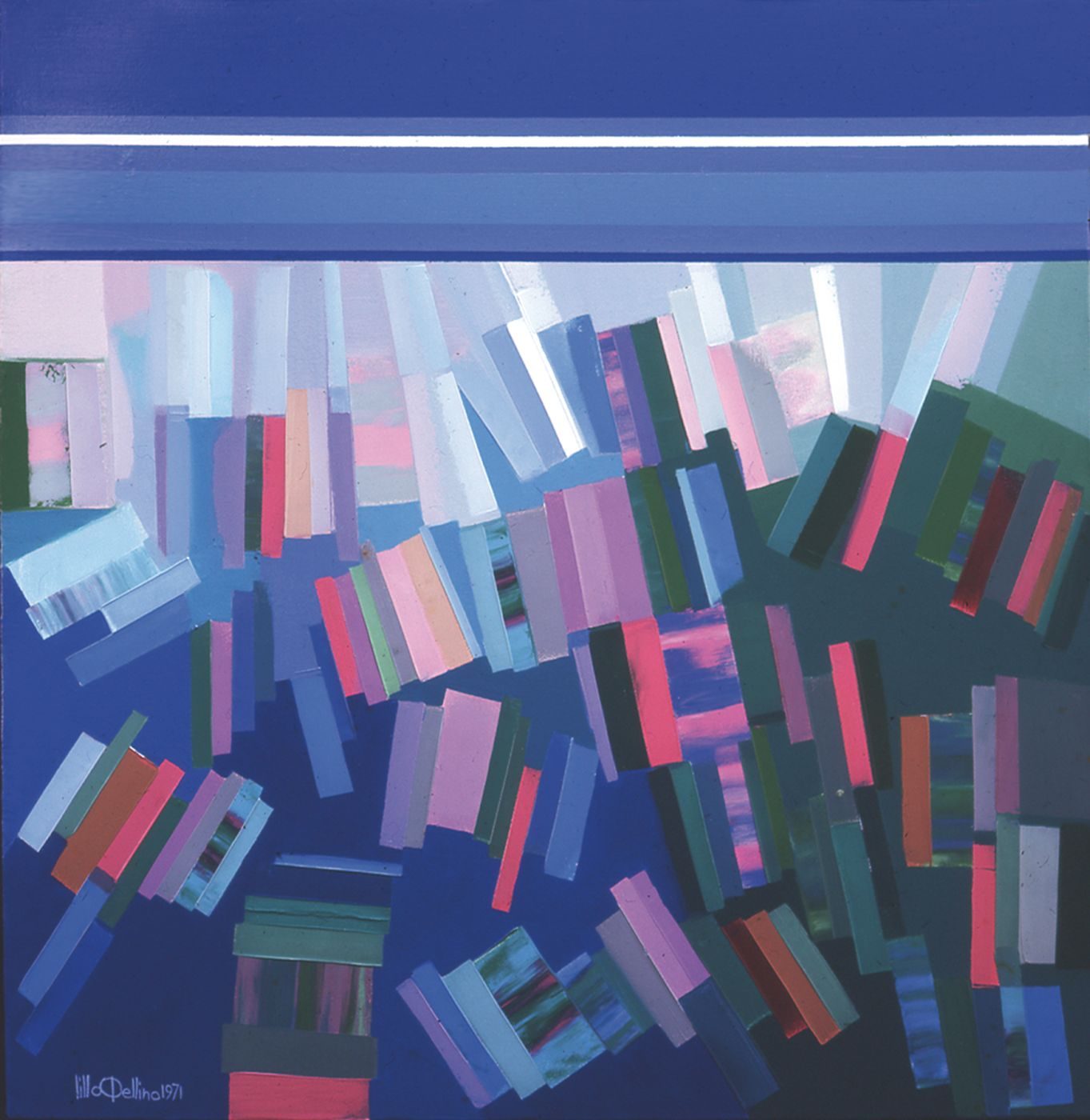
Abstract
Posters
Carmelo Bene in “Majakowskij”Teatro Petruzzelli, 1980–81 seasonStudio TeatroHouston Ballet in “Giselle”Camerata Musicale Barese, 1982Giovani artisti nella RDT (Young Artists of the GDR)Bari, Castello Svevo, 1977
Secular
KorePiumaL’albero della vita
Sacred
OdegitriaLumen de lumineSanta Caterina
Lithographs
SirenaLithographSanctus NicolausLithograph
A story
The Secret Seabed
by Dario Dellino
“Don’t look at the flat, smooth surface of the sea – think of what lies hidden beneath it: its secret seabed.”
The journey to Paris in October 2013, told by his son.
The full text is available in Italian and in French.